About the film (courtesy of A24):
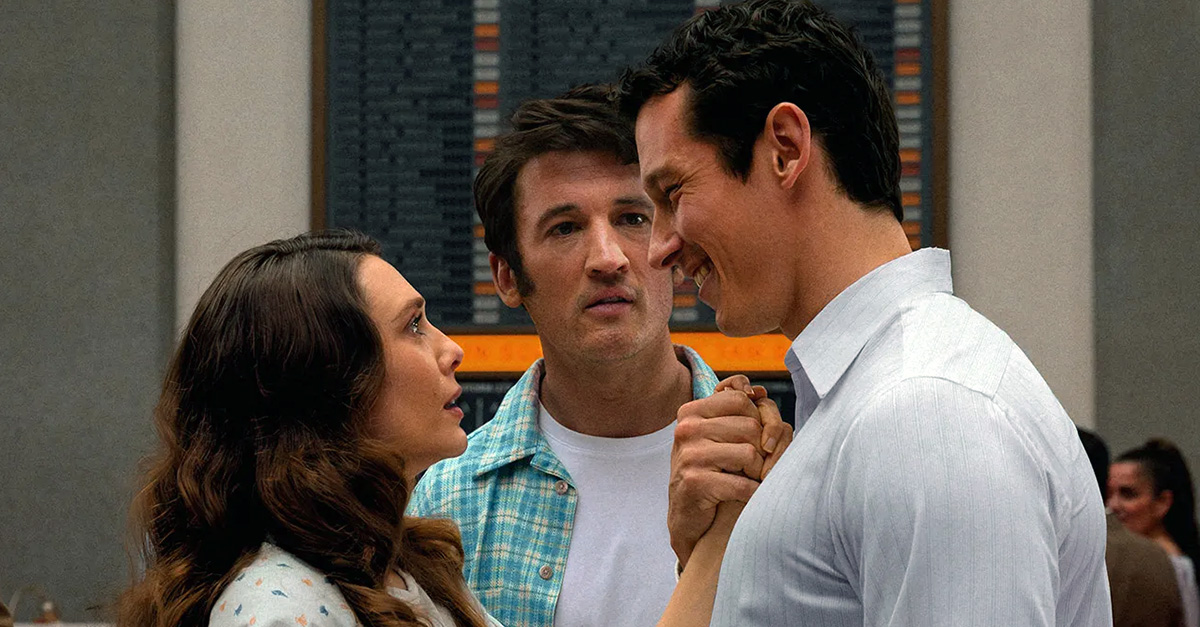
In an afterlife where souls have one week to decide where to spend eternity, Joan (Elizabeth Olsen) is faced with the impossible choice between the man she spent her life with (Miles Teller) and her first love (Callum Turner), who died young and has waited decades for her to arrive.
David Freyne’s Eternity arrives with a premise that’s instantly intriguing: in a luminous way-station between life and the afterlife, newly departed souls are given seven days to decide who and where they’ll spend eternity with. It’s the kind of high-concept idea that could easily collapse under its own sentimentality, yet Freyne, best known for The Cured (2017), handles it with tenderness and restraint. The result is an experience that’s enjoyable and beautifully acted, though at times too restrained for its own good.
Elizabeth Olsen anchors Eternity with a performance that quietly outshines everything around her. She plays Joan, a woman torn between two great loves from different chapters of her life Larry (Miles Teller), her steady partner who truly understands her, and Luke (Callum Turner), her first love, whose memory has haunted her for years. Olsen conveys both yearning and emotional fatigue in equal measure. She manages to make Joan’s indecision feel not frustrating, but painfully human, a rare feat in romantic fantasy.
Teller, meanwhile, grounds the film as Larry, the man who sees Joan for who she truly is and lives to make her happy. Their chemistry feels lived-in, affectionate, and deeply empathetic. Teller gives one of his more understated performances here, allowing small gestures and moments of understanding to say more than the dialogue. Turner, as Luke, brings charm and nostalgia, though his role serves more as a mirror to Joan’s internal struggle than as a fully developed counterpart.
The world Freyne builds, the “Junction,” a tranquil purgatorial realm where “Afterlife Coordinators guide souls toward their eternal decisions, is both conceptually rich and emotionally resonant. It’s not just a setting; it’s a metaphor for reflection, closure, and the uncomfortable beauty of letting go. The “Aftelife Coordinators, Anna and Ryan themselves (played by Da’Vine Joy Randolph and John Early) inject some levity, but their characters could have been used more effectively. The main way I could have seen this being done is by exploring “The Junction” further and fleshing it out more. Eternity hints at deeper stories within their realm that never quite materialize, which is a shame, as they bring welcome texture to the otherwise polished emotional landscape.
Tonally, Eternity balances its romantic and metaphysical ambitions with surprising cohesion. It’s part love story, part existential meditation, and part gentle comedy of manners between the living and the departed. Still, it occasionally drifts into monotony. At nearly two hours, the pacing falters—especially in the middle act, where the repetition of emotional beats makes the film feel longer than it needs to be. Trimming 20 to 30 minutes of the movie’s runtime could have made its emotional arcs land with greater precision.
Visually, though, Eternity is exquisite. Freyne and cinematographer Suzie Lavelle bathe each frame in dreamlike tones, soft pastels and diffused light that evoke both comfort and melancholy. The soundtrack, an airy mix of piano and ambient echoes, reinforces the sensation of time suspended within its environment.
If the film stumbles, it’s in its ending, which can certainly leave some audiences feeling underwhelmed by its conclusion. Yet even still, Eternity leaves viewers reflecting on what defines love and legacy whether eternity is found in forever, or in the fleeting moments that make life worth living.
Eternity opens in theaters everywhere starting Wednesday, November 26th, just in time for the long Thanksgiving weekend.