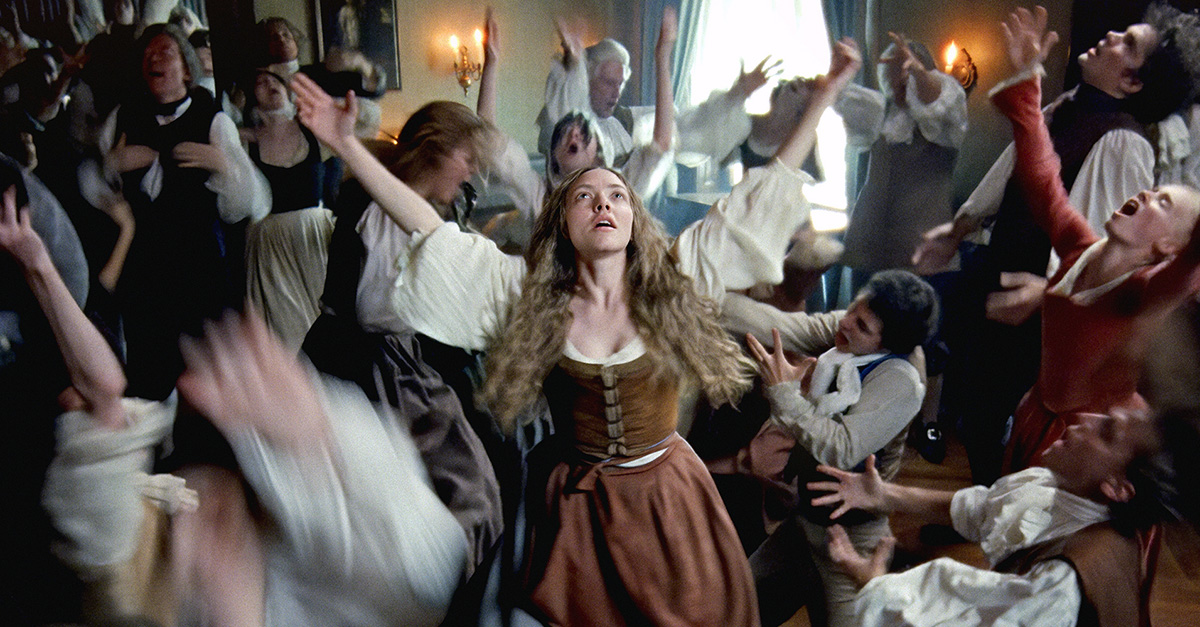
About the film (courtesy of Searchlight Pictures):
The story of Ann Lee (Amanda Seyfried), founder of the Shakers, who preached gender and social equality. Revered by her followers as the female reincarnation of Christ, her quest to build a utopia comes to life through song and the movement in the world of The Testament of Ann Lee.
Mona Fastvold’s directorial effort, The Testament of Ann Lee, arrives with high expectations, primarily due to the casting of Amanda Seyfried. The film attempts to translate the intriguing, real-life story of Ann Lee into a compelling historical drama, laced with musical sequences. While Seyfried delivers the strong, well-acted performance audiences have come to anticipate, the overall production struggles significantly with structural deficiencies, chief among them being its excessive length. This feature ultimately becomes a frustrating experience of strong potential hampered by uneven execution.
The Testament of Ann Lee serves as the latest entry in Amanda Seyfried’s notable history with musical productions, following her beloved turns in the Mamma Mia! franchise and the critically acclaimed adaptation of Les Misérables (2012). Her participation alone raises the bar for the musical elements of this historical narrative. Though her performance is “well-acted,” suggesting Seyfried fully embodies the complexity of the historical figure, this strength is not enough to carry the nearly two-and-a-half-hour runtime.
A solidly acted historical drama is the foundation of any cinematic success, but when that foundation is coupled with flat moments and poor pacing, the audience’s engagement inevitably wanes. The supporting cast of Lewis Pullman, Thomasin McKenzie, Christopher Abbott, Stacy Martin, and Tim Blake Nelson helps with the effectiveness of the story telling, but doesn’t help in terms of musical performances.
The Testament of Ann Lee’s musical nature should inherently lend itself to dynamic pacing and emotional high points, but the length suggests these moments may be too sparse or insufficiently impactful to justify the comprehensive running time. The ability of the actor to draw viewers in is paramount, and it is unfortunate that even a performance of Seyfried’s caliber cannot compensate for a sluggish narrative.
Clocking in at 137 minutes, The Testament of Ann Lee clearly suffers from self-indulgence. In modern filmmaking, such a significant runtime must be rigorously earned by a plot that is consistently engaging and essential in every frame. The story overstays its welcome which points to an unforgiving and woefully unaware editing process or a lack thereof, which allows the historical beats to drag and the dramatic tension to dissipate.
For a film to become one of an actor’s more enjoyable musical fares, it requires not just a captivating lead, but a rhythm that propels the story forward. Unfortunately, the presence of flat moments confirms that The Testament of Ann Lee fails to maintain the necessary momentum. Pacing problems of this magnitude can often overshadow any merit in the acting or source material.
Given the challenging length and structural issues, my prediction that The Testament of Ann Lee will surely struggle upon its theatrical release, both limited, but more so wide. Audiences these days are often unforgiving of films that do not respect their time, especially ones with a more narrow demographic such as this.
Ultimately, Mona Fastvold has delivered a movie with a fascinating subject and a talented lead, but one that falls short of its potential due to fundamental issues in pacing and editing. While Amanda Seyfried’s presence ensures the performance aspect is compelling, the film’s tendency to drag and include dull stretches prevents it from reaching the heights achieved by her previous work in the musical genre. This is a viewing experience that rewards patience but punishes the clock.
The Testament of Ann Lee receives a limited theatrical release December 25th and a wide release Friday, February 20th.