About the film (courtesy of Focus Features):
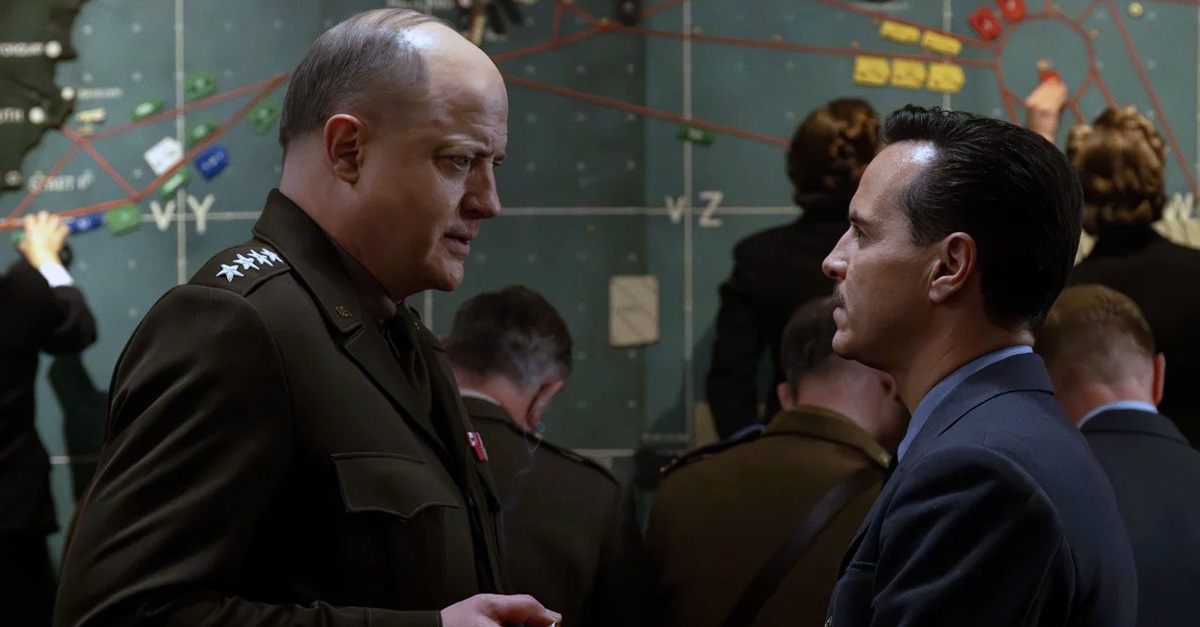
In the tense 72 hours before D-Day, and the fate of the free world hanging in the balance, Pressure follows General Dwight D. Eisenhower and Captain James Stagg as they face an impossible choice— launch the largest and most dangerous seaborne invasion in history or risk losing the war altogether.
Who knew that a film about feuding meteorologists could be so gripping? Essentially, this is exactly what happens between James Stagg (Andrew Scott) and Irving Krick (Chris Messina) as each presents polar opposite viewpoints to General Dwight “Ike” Eisenhower (Brendan Fraser). Their heated exchanges are guaranteed to raise the temperature as the war between the Allied Front and Germany wages on. The narrative brilliantly transforms what could have been a dry, technical debate into a high-stakes psychological chess match, proving that some of the most critical battles of World War II were fought with barometers rather than bullets.
Pressure is a powder keg that is constantly on the verge of exploding. Nerves are frayed and tensions are sky-high with the immense weight of human history hanging in the balance. Director and co-writer Anthony Maras does an admirable job of turning weather forecasting into an incredibly dramatic, life-or-death endeavor. For the vast majority of audiences, the massive, pivotal role that meteorological data played in the success or failure of the Normandy landings will be an absolute revelation. The filmmaking captures the claustrophobia of the decision-making rooms, making the audience feel every drop of atmospheric change right along with the characters.
Brendan Fraser, Andrew Scott, Chris Messina, and Kerry Condon all give excellent performances in Pressure, bringing their characters to life with incredibly raw emotion. Scott shines as the rigidly precise Stagg, anchoring the film with a quiet, desperate intensity, while Messina provides the perfect swaggering foil as the overconfident Krick. Fraser delivers a remarkably grounded, weary portrayal of Eisenhower, effectively conveying the crushing burden of a commander holding hundreds of thousands of lives in his hands. Condon elevates her scenes as well, providing crucial emotional depth to a high-stress environment where every second counts.
Unlike some other sprawling war films of the past, such as Oppenheimer (2023) or Saving Private Ryan (1998), Pressure does not overstay its welcome, clocking in at a lean and efficient 100 minutes. This tight runtime allows the pace to keep moving forward at a steady clip. A brisk tempo is paramount, considering the plot crux is built entirely on meteorology. It is not as if the story relies on the overt, CGI-driven spectacle found in Twister (1996), The Day After Tomorrow (2004), or the campy chaos of Sharknado (2013). Instead, the suspense is purely intellectual and interpersonal, relying on sharp dialogue and escalating conflict to sustain its energy.
Ultimately, Pressure is a good, solid war drama that demands a closer look from history buffs and cinephiles alike. By focusing on a fascinating, overlooked footnote of the D-Day invasion, it delivers a gripping theatrical experience driven by top-tier acting and an incredibly compelling plot. It stands as a powerful testament to the unsung heroes behind the scenes of history, proving that entertainment can be found in the most unexpected places.
Pressure releases into theaters starting Friday, May 29th.