About the film (courtesy of Focus Features):
Andrew Garfield stars as the legendary leader of a ferocious rebellion against the tyranny of King Richard II. As war burns across England, he forms an army of the people to face the King’s might in a fight for justice and survival.
A rebellious romp through post plague Europe in 1381, The Uprising is a mess of a movie directed by Paul Greengrass. Led by The Ploughman (Andrew Garfield), John Ball (Jamie Bell), and Wat Tyler (Cosmo Jarvis), the film tells the story of the rebellion against a young and impressionable King Richard II.
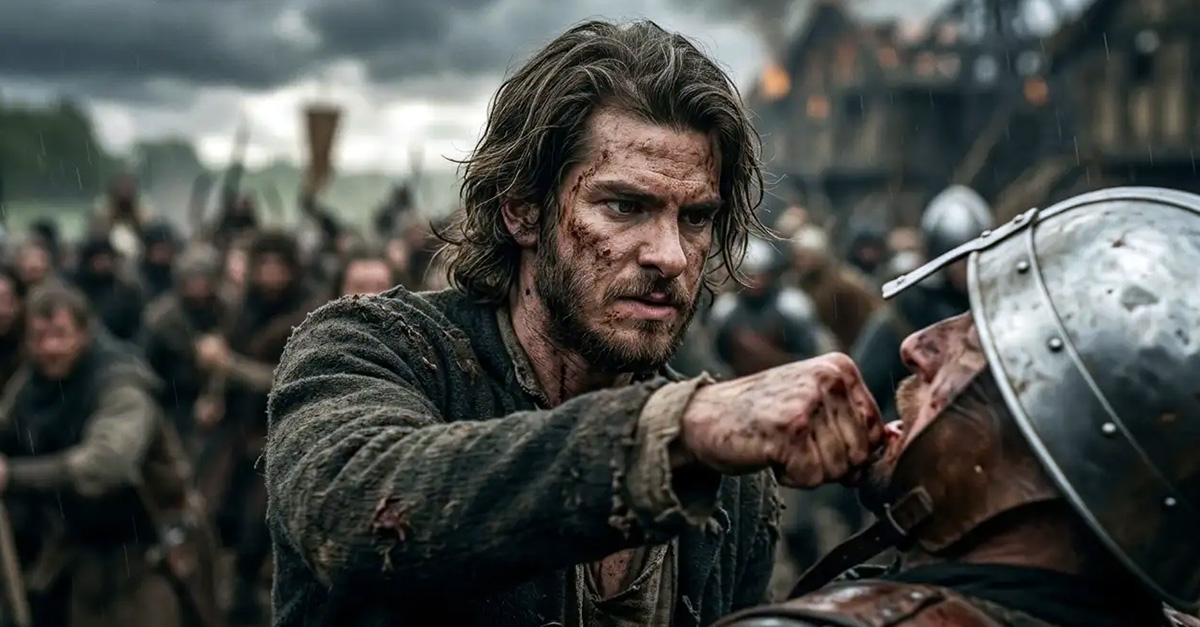
The Uprising opens with an unsuspecting Ploughman thrust into a position of watching as the world around him unravels into extreme injustice. Placed in a losing situation, the farmer decides to act and a mini coup begins in his small village. This opening act is seemingly the most coherent and well structured part of the movie where The Ploughman’s heroism has a chance to shine while making some questionable decisions (for example his character headbutts a fully armored and helmeted king’s man). This narrow single village action sequence is what the whole movie could have felt like, but it instead rapidly descends into chaos.
Upon hearing word that this minor rebellion had taken place and the king’s men had temporarily been pushed back, other neighboring towns begin to take up arms and wage war against their respective oppressors. This is when Ploughman meets the remaining members of what would essentially become a less developed version of the three musketeers and the beginning of the real Uprising.
The three men along with a militia spearheaded by Wat Tyler, a former soldier in the king’s army, lead the resistance with a stoic sense of morality and justice while John Ball, a sycophantic Catholic, joins in preaching about how the governing forces have become unjust and that wealth has become a sign of great sin. The Uprising rushes past these characters’ introductions and only mentions them further briefly in passing, which becomes a recurring trend for most of the cast.
Sparing no time for much more detail than the previously mentioned story parts, the film jumps to a teenage King Richard II. Haunted by nightmares and the death of his father, he resorts to cowering in his room for much of The Uprising’s rising action and instead leaves the majority of the ruling to his court of selfish and corrupt councilors. The film highlights how well off these heads of state are, after all but literally cudgeling the audience over the head with the inequities of the people that they are meant to rule.
The Uprising however, does nothing to make the audience feel any type of way about the people on either side of this engagement, as it works off of the presumption that the injustice alone is enough to create a tie to the main entourage of rebels. But it dismisses any semblance of sympathy fairly early on when it shows the pillaging and burning homes and towns that they come across on their quest to question the king.
The few saving graces of The Uprising come in the form of incredible set pieces and sound design that truly pull viewers into medieval Europe. One can practically smell the smoke in the air while the galloping of horses echoes through one’s chest. The clashing of metal and the crushing weight of the headsman’s axe can truly be felt while witnessing scenes that are best depicted at a modern day renaissance festival.
A film with the premise and cast to have been great, The Uprising is nothing short of a disappointment. While still worth watching to those interested, it simply continuously falls short of expectations and fails to deliver on those ideas. A cinematic piece that seems to fan the flames of rebellion in a tone similar to what The Hunger Games set in the 2010s, it just adds much more gore and a touch of realism to the dystopian world.
The Uprising attempts to liberate fortune from those who dare to venture out to see this film when it opens in theaters on Thursday, September 10th. My advice would be stay vigilant fellow moviegoers and wait until a home release instead.